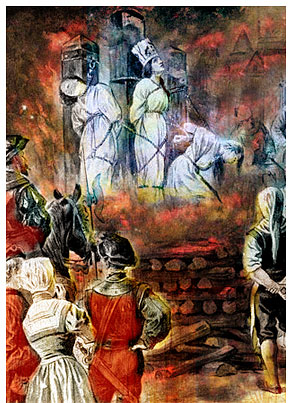
This is an impressively erroneous passage, incorrect almost from beginning to end, but it iscontaminated by one morsel of fact: The “Malleus Maleficarum” is indeed a spectacularly misogynistic and twisted book, compiled by the Dominican inquisitors Heinrich Kramer and James Sprenger, published in 1486 and an essential guidebook and inspiration for witch hunters throughout Europe.
For many years, such volumes of demonology (“findings” on the behavior of demons, witches and their master, the devil) were the main sources for historians of Europe’s witch hunts, including such revisionist feminist historians as Margaret Murray and Anne Llewellyn Barstow. The trouble is, demonology texts like “Malleus Maleficarum” — alarmist calls to arms in a society where many people were skeptical about the threat posed by witches — amount to advertisements and arguments for the profession of witch hunting. When it comes to what actually happened in the real world, they’re about as trustworthy as the Swift Boat Veterans for Truth.
In the past two or three decades, however, many historians have turned their attention to more reliable source materials on the witch hunts — the local records of trials and executions stashed away in hundreds of small towns across Europe and Great Britain. As the historian Jenny Gibbons has pointed out in her admirably lucid 1998
essay “Recent Developments in the Study of the Great European Witch Hunt,” this is hard work, sifting through vast amounts of dull documents written in archaic and often frustratingly obtuse language, but it’s the sort of thing real historians do. And it’s given us a radically new picture of what Europe’s witch hunts were like.
Lyndal Roper’s “Witch Craze: Terror and Fantasy in Baroque Germany” isn’t the first such book to explore this new front of witch hunt scholarship, although it is one of the most recent. But it is representative, and as such it doesn’t offer a version of history that features a big, clear, satisfying story with an obvious villain. Like other studies — Robin Briggs’ “Witches and Neighbors” and Brian Levack’s “The Witch-Hunt in Early Modern Europe” are two of the best known — it is crammed with little stories: squabbles among neighbors, resentments within families, disagreeable local characters, the machinations of small-time politicians and the creepy psychosexual fixations of magistrates and clerics.
The mass of detail can be numbing, but what it reveals is important: not a sweeping, coordinated effort to exert control by a major historical player, but something more like what Hannah Arendt called the “banality of evil.” Witch hunts were a collaboration between lower-level authorities and commonfolk succumbing to garden-variety pettiness, vindictiveness, superstition and hysteria. Seen that way, it’s a pattern that recurs over and over again in various forms throughout human history, whether or not an evil international church or a ruthless patriarchy is involved, in places as different as Seattle and Rwanda.
As a professor of early modern history at Oxford, Roper takes for granted several historical facts that may nevertheless be unfamiliar or surprising to the average reader. One concerns the diversity of the persecuted people. Some 20 percent of the Europeans tried for witchcraft were men. (This varied from nation to nation; in Iceland, 90 percent of the accused were men.) In some cases, including one that Roper covers in depth, the accused were children.
The peak of the craze occurred not in the Middle Ages, when witchcraft was dealt with rather leniently, but a couple hundred years later. The practice had effectively died out by the late 1700s, but Roper also describes a particularly brutal trial that happened in 1745. The total number of Europeans killed is generally thought to be 40,000 to 100,000. (It’s not clear where Dan Brown, author of “The Da Vinci Code,” got the figure of 5 million, since 9 million is the incorrect number more commonly bandied about.)
There’s more. The Inquisition was not greatly involved in witch burnings; it had its hands full with Protestants and other heretics, whom the church shrewdly perceived to be a far more serious threat to its power. In fact, while the justification for condemning witches was religious, and some religious figures joined in witch hunting campaigns, the trials were not run by churches of any denomination. They were largely held in civil courts and prosecuted by local authorities (some of whom were also religious leaders) as criminal cases.
The old-school take on Europe’s witch hunts attributed them to excesses of Catholic fanaticism, but as Roper, who focuses on witch crazes in small German towns, points out, Protestants of many denominations could be just as fervent and murderous in their campaigns. (The need to eradicate witches was one of the few doctrinal things Catholic and Protestant crusaders agreed on.) A witch panic, she writes, was less the act of a ruthless authority stamping out all dissenters than a sign of a power vacuum: “The very fragmentation of political and legal authority in Germany made it possible for panics to get out of hand, while the intensity of religious struggle, with the forces of the Reformation and Counter-Reformation confronting each other directly, nourished a kind of moral fundamentalism that saw the Devil’s hand at work in all opponents.”
Roper, who has previously studied the witch hunts from a psychoanalytic perspective, is especially interested in what she calls the “fantasy” aspects to the accusations. The stories are remarkably similar and, she writes, “had a great deal to do with local conditions.” (She feels you can learn a lot about regional customs such as courtship practices by observing how they are mirrored in witches’ confessions.) Here’s a typical accusation, summarized by Roper:
“Madalena Mincker of Nvrdlingen described how her child was harmed ‘while it was in swaddling bands.’ An old woman, Margretha Knorz, had come to visit her while she was in childbed without being invited, and had stayed until she had bore the child. She had brought her wine, apples and milk, but they had a disagreement about money, and Knorz told the young mother she would rue this. Just three weeks of her lying-in had passed when the child sickened, eventually becoming ‘quite lame and crippled of hands and feet.’”
Most of the complaints concerned pregnant women, infants, young children and lactating mothers who suffered from unexplained and sometimes fatal maladies. Such misfortunes were commonplace at a time when only half of all babies made it past their first birthday. If the mother or her family felt inclined to blame this on supernatural forces, the most likely culprit to single out would be an elderly woman who had some encounter — even a seemingly benevolent one — with mother or child.
According to Roper, Germany in the late 16th century was a place where marriage and children were difficult to attain. Laws prevented people from marrying unless they could demonstrate their ability to support a family, and illegitimate pregnancies were harshly punished. To be a wife and mother was to have scored a privileged station in life — and to be the object of much envy. Witches, especially elderly women, people believed, were motivated by jealousy and spite, seeking terrible revenge for minor slights and begrudging young and fertile women the blessings they could no longer enjoy themselves.
It’s important to note here that the belief that envy toward the more fortunate could be transformed into a curse — basically, the evil eye — can be found in tribal cultures all over the world. A woman whose child dies or who mysteriously finds herself unable to produce milk, can deflect the (unreasonable) blame that might be attached to herself by fingering a person who’s low in the village pecking order. The evil eye is not a particularly Christian idea, and early on the church actually discouraged members from clinging to old folk beliefs in magic and evil sorcerers because they were inconsistent with church doctrine.
Current popular history holds that the witch hunts were concerted campaigns by a male-dominated church that felt its sway diminished by stubborn pagan and folk traditions that gave too much respect to wise old women. The persecution, the story goes, was designed to stamp out those beliefs. However, when you look at actual cases, the picture is quite the opposite. “In 1627,” writes Roper, “in the town of Ochsenfurt, rumors about witchcraft had involved the allegation that a child had been eaten … Later that same year, 150 citizens gathered in force to complain about ‘the enemies of their livelihood, and vermin and witchcraft,’” and to demand action. Against the bishop’s express orders, the mayor and council arrested and tortured several suspects, causing the death of one.
Of course, many times the local church authorities participated enthusiastically in the persecution, but in most cases, the community itself started it. The church used trials and demonology texts that detailed and classified diabolical behavior to impose order on the chaotic paranoia of villagers looking for scapegoats for their own misfortunes. Most of us have heard that Christianity incorporated such pagan and folk traditions as the winter solstice festival (Christmas) and the spring festival (Easter) into the Christian calendar. There’s every reason to believe that — far from seeking to eradicate folk beliefs in black magic — Christian churches took advantage of ancient superstitions by stepping in to offer themselves as a solution to the mischief done by evil sorcerers. No wonder the witch hunts got bloodier when Catholics and Protestants were competing for followers.
And if the victims of witch hunts were disproportionately older women, their chief accusers, and the initiating force behind many of the trials Roper details, were often women, too. Young mothers, overwhelmed by the demands of newborn infants and raised in a world where everyone believed that angry or negative thoughts could cause serious physical harm, cast about for someone to blame when something went wrong. In an old woman they saw someone with cause to resent their good fortune as well as a reminder that their youth and fecundity, too, would someday be gone. In some cases, a midwife was simply the old woman most likely to have had contact with a new mother and her child, and therefore a prime target.
None of this excuses the Catholic and Protestant churches for the many atrocities they’ve perpetrated over the centuries, against “witches” or anyone else who earned their disfavor. But it’s also a caution against idealizing a pagan past about which we know next to nothing. The pagan cultures that have left records have proven themselves every bit as capable of misogyny and of senselessly brutalizing outsiders and misfits. As human beings, pagans were just as capable of barbarity as monotheists; and as human beings, women can be just as wicked as men, given half a chance.
The history of the witch hunts also offers a caution against reflexively glorifying the “community” offered by small towns and villages when the bonds of such communities are too often cemented by tormenting their marginal members. This perhaps is the most chilling thing about the stories Roper has gleaned from the antique documents she has unearthed in so many small German towns: their ordinariness. However grotesque the tortures and executions to which the victims were subjected, however bizarre their coached confessions of flying on the backs of goats to witches’ Sabbaths to eat roasted babies on silver platters, the origins of most of the accusations are pretty mundane.
A gift of baked goods that comes with a barbed remark about the recipient’s own culinary skills, a quarrel over the price of apples, irritation at someone who doesn’t come promptly to dinner when called — these are the sorts of incidents that precipitated the hideous cruelty of Europe’s witch hunts. “It is difficult to comprehend the sheer viciousness of the way villagers and townsfolk attacked those they held to be witches,” Roper writes. Then again, if you’ve ever lived in a small community, is it really that difficult to see how they got started in that direction, if not how they managed to get so far? It may take a village to raise a child, but history also keeps telling us that it takes a village to burn a witch.